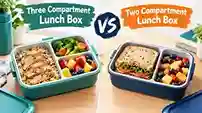
Three Compartment Lunch Box vs Two Compartment Lunch Box Whether you’re packing lunch for school, work, travel or outdoors, getting it right from the start with the right lunch container can make everyday meal preparation easier. The biggest difference between a 3 compartment lunch box and a 2 compartment lunch box is how your food is organized, the amount of space available, convenience, and your eating habits.
Both are good practical solutions for transporting homecooked meals and keep various foods in order. The two-compartment and three-compartment designs both have their advantages, with the latter providing extra separation for sides and snacks, and the former offering a simpler design that is suitable for many regular meals. Knowing what they offer will make it easier to choose the most suitable lunch box to fit your lunch schedule.
What is a 3 compartment lunch box?
A three compartment lunch box is a lunch box with three compartments inside. These sections enable you to pack various foods including rice, vegetables, chicken, fruit and snack without having to put everything in one open area. The compartments can be of equal or unequal sizes.
These types of lunch containers are particularly beneficial for people who enjoy well-balanced meals with numerous parts. Students may bring a main course and two side dishes, and office staff can plan lunch without bringing around a bunch of little containers. These may also have removable dividers, secure lids, and/or microwave-safe materials, depending on the model.
So, what is a two compartment lunch box?
Two compartment lunch box has a two-part division in the interior of the box. Reasonable option for those who don’t want multiple areas and want simple meal preparation. One section can be used to hold the main course, the other for vegetables, fruit, bread or another side dish.
These lunch boxes are made from plastic, stainless steel, insulated or other materials. Others are light and small enough to fit in a school bag, backpack or work tote. They are also easier to clean and pack as they have simpler designs, especially if you typically go with just two categories of food.
Three Compartment Lunch Box vs Two Compartment Lunch Box: Main Differences
The most noticeable difference between these containers is the number of food sections. However, the right choice depends on more than compartment count. Size, depth, lid design, material, and overall capacity can make a significant difference in everyday use.
| Feature | Three Compartment Lunch Box | Two Compartment Lunch Box |
|---|---|---|
| Food sections | Three | Two |
| Meal organization | Suitable for a main dish and two sides | Suitable for a main dish and one side |
| Portion separation | More separate spaces | Fewer separate spaces |
| Packing flexibility | Useful for varied meals | Useful for simple meals |
| Cleaning | May have more corners and dividers | Often has a simpler interior |
| Portability | Depends on overall size | Often available in compact designs |
| Best use | Meals with multiple components | Everyday meals with fewer components |
Remember that a three-compartment model is not automatically larger than a two-compartment model. Always compare the total capacity and internal dimensions before purchasing.
Three Compartment Lunch Box
If you prefer to have a “clean” lunch box without having to carry multiple containers, then you should consider a 3 compartment lunch box. It has a split inside that offers separate compartment for different meals, which will help you to organize your meals neatly. For instance, if you have three sections you might fill one with pasta, one with vegetables and one with fruit.
This container can have a leak proof lid, reusability of the container, or the ability to be used in the school or office setting. When selecting one, verify the size, material, and cleanability, and compartment sizes. This information will assist you to know if it is suitable for your daily diet.
The benefits include flexibility. Can make a variety of lunches in one box. Small areas, however, do not always accommodate large quantities, and sauces could flow through small areas if the dividers or lid are not made to fit tightly. Pick the model based on the meals you like instead of just the number of sections.
Value
Organizes food for easy consumption for those who like having main courses and side dishes.
Key Features
There are three different food compartments.
Assists with arranging various parts of a meal.
May be available in plastic or stainless steel.
Some models have dividers or lids that can be taken out.Some models have removable dividers or secure lids.
Depending on its size, it can be chosen for use in school, office or traveling.
Pros
Carries two food items in a container.
Helps to plan diverse meals.
May be able to cut down on the need for additional small containers.
Facilitates easy food preparation.
Cons
There are some models with smaller individual components.
Additional corners might need extra care when cleaning.
Not all designs will be watertight.
If you’re using a bigger size, you’ll need more bag space.
Recommended
Suggested for individuals who frequently pack a primary dish, fresh greens, fruits or several side dishes.
Best For
Students, office workers, meal-prep lovers and everyone who loves a well-rounded lunch.

Two Compartment Lunch Box
This two compartment lunch box is ideal for those that like simple meals and easy packing. It is separated into two parts that will give you sufficient space for most common pairings like a sandwich and some fruit, or vegetables and rice, or pasta with a side dish. The design may also be helpful if you prefer to have two items of food apart from the main course.
There are a number of two-compartment containers which come in small configurations that can fit into lunch bags and backpacks. Others may include stainless steel interiors, insulated construction or materials that are microwave-safe. All these benefits are product dependent, so check the manufacturer’s specifications prior to making a choice.
The easy layout may be a draw for those who appreciate maintenance. With fewer divided spaces, certain models are easier to wash and dry. However, the two sections might not be sufficient for a menu with multiple sides. When packing sauces, snacks and various foods regularly, the food space requirements of available compartments should be considered.
Value
Offers a quick and easy solution to divide two ingredients of a meal while maintaining the convenience of packing.
Key Features
Two special food displays.
Perfect for all day meals.
Come in various sizes and materials.
Secure lids and dismantle parts are features of some models.
For home packed lunches and everyday wear.
Pros
Easy to set-up for an easy meal.
Good for most typical lunches.
Can be compact and easy to carry.
It can be easy to clean some designs.
Will provide adequate space for a primary course and side course.Will provide sufficient distance for a principal course and side course.
Cons
Small space to separate multiple foods.
May not be appropriate for multi-component meals.
When it’s smaller, you may not eat as much.
The level of leakiness and insulation differs from model to model.
Recommended
Suggests for those who typically include two primary food items in their lunch and prefer a straightforward lunch box.
Best For
Students, commuters, office workers and anyone who wants a simple meal with minimal packing.

Which Lunch Box Provides Better Food Organization?
Food organisation is the main goal – the 3 compartment lunch box usually wins this one. It provides you with extra compartment for separating foods, which might be useful if you’re making an entire meal with a few side items. Portions can be neat and convenient, and each food available easily.
A basic meal still requires a two compartment lunch box. An extra compartment isn’t much use if you always pack a sandwich with fruit or a main meal with veggies. The ideal design is the one that fits your eating pattern without taking up any extra room.
Rethinking School?
Both designs are suitable for school lunches. Children and teens may find a three compartment container helpful to take a main meal, fruit and snack to school. It keeps various foods apart and can help organize lunches.
If the student prefers a sandwich with fruit or a simple sandwich, a two compartment container may be more appropriate. It’s worth noting that factors such as weight, size, lid security and opening convenience are all important. Ensure the container is easy to fit into the school bag and is easy for the student to open and close.
So which is advisable for office workers?
For office workers who make lunches with multiple ingredients, a 3 compartment lunch box might be preferable. It can hold a main course and two smaller items, which allows for a more diverse lunch when taking to work. This could also decrease the number of containers in a work bag.
For a simple lunch, though, a two-compartment model will work. If your office and/or apartment has a refrigerator or microwave oven, determine if the container is appropriate for your storage and reheating habits. Certain materials and lids are not microwave-safe, and containers that are insulated may have instructions for how to heat them.
Which is easier to clean, A or B?
The cleanliness will depend largely on the material, inner shape, lid and removable dividers. A 2 compartment lunch box can have fewer corners and surfaces making it fairly easy to clean. This can be especially useful if you have a container that you use daily.
If the lunch box features smooth surfaces and rounded corners, it is also simple to clean. Keep in mind, however, that there can be food particles around the edges of the dividers, so be sure to check there. Wash according to the manufacturer’s guidelines, particularly those for insulated containers, silicone seals and stainless steel parts.
Which Method is the Better For Fresh Food?
Food freshness does not automatically increase with a different design of the compartments. Freshness is dependent on the closeness of the container, ingredients, storage temperature, and the amount of time between preparing food and consumption.
For ready-to-keep food, find one that is labeled as a temperature holder. If needed, use an insulated lunch bag, or cold-packs, and follow food safety guidelines for perishable food. A divided container will organize the food; however, it will not take the place of proper temperature control.
Price and Overall Value Three Compartment Lunch Box vs Two Compartment Lunch Box
The cost of a Lunch Box depends on the type of material, capacity, construction, brand and additional features. The cost of a 3 compartment model is not just related to the number of compartments, it can be more expensive if it has special dividers or a complicated design.
If it fits your daily requirements, a two compartment lunch box can prove to be a great value. Check out the durability, cleanability, quality of the lid, capacity and warranty (if available) before buying either item. If a higher priced product is more durable and more suitable for your lifestyle, it might be worth it.
How to Choose the Right Lunch Box
Before purchasing, consider these practical factors:
- Meal type: Decide whether you usually pack two foods or several separate components.
- Capacity: Check the total volume and the dimensions of each compartment.
- Material: Compare plastic, stainless steel, and other available materials.
- Leak resistance: Look for a well-fitting lid and reliable seals if you carry moist foods.
- Portability: Ensure the container fits your lunch bag or backpack.
- Cleaning: Choose a design that is easy to wash and maintain.
- Temperature needs: Check whether insulation or a separate thermal bag is necessary.
- Budget: Compare features and durability rather than choosing based on price alone.
These points will help you find a container that provides practical value over time.
Conclusion
When comparing a three compartment lunch box vs two compartment lunch box, the best choice depends on how you prepare and pack your meals. A three-compartment design is generally better for people who want to separate a main dish and multiple sides in one container. It offers more flexibility for varied lunches and can simplify meal organization.
A two-compartment lunch box is a sensible choice for people who prefer simple meals, compact storage, and straightforward cleaning. It can handle many everyday combinations without requiring extra sections. Before buying, compare capacity, materials, lid quality, and cleaning requirements. Ultimately, choose the lunch box that fits your routine, your preferred meals, and your budget.
Final Thoughts
Both lunch box styles offer practical benefits for everyday use, and neither is the perfect choice for everyone. The three compartment lunch box provides greater flexibility for people who enjoy a variety of foods, while the two compartment lunch box is ideal for those who prefer simple, organized meals. Consider your daily routine, portion requirements, storage space, and budget before making a purchase. By comparing these features carefully, you can choose a durable and convenient lunch container that makes preparing meals for school, work, or travel easier.
Frequently Asked Questions (FAQ)
1. What is the difference between a three compartment lunch box and a two compartment lunch box?
A three-compartment lunch box has three separate food sections, while a two-compartment lunch box has two. The three-section design provides more flexibility for varied meals, whereas the two-section design works well for simpler combinations.
2. Is a three compartment lunch box better for school?
It can be a good choice for students who want to pack a main dish, fruit, and a snack separately. However, a two-compartment model may be more practical for students who prefer simpler meals or need a smaller container.
3. Is a two compartment lunch box enough for adults?
Yes. A two-compartment lunch box can be suitable for adults who pack a main dish and one side. The right capacity depends on the portion size and the types of food you normally bring.
4. Can I put hot food in a three compartment lunch box?
That depends on the material and the manufacturer’s instructions. Check whether the container is designed for hot food and whether it can safely be used in a microwave. A regular lunch box does not necessarily keep food hot for extended periods.
5. Which lunch box is easier to clean?
A two-compartment lunch box may be simpler to clean because it often has fewer divider edges. However, smooth surfaces, removable dividers, and dishwasher compatibility, where specified, matter more than the compartment count alone.
6. Do three compartment lunch boxes prevent food from mixing?
They help keep different foods separated, but they do not guarantee complete leak protection. Liquid foods and sauces may move between sections unless the container has suitable seals and a leak-resistant design.
7. Which lunch box is better for meal preparation?
A three-compartment lunch box is useful for preparing varied meals with multiple sides. A two-compartment model is suitable for simpler meal plans. Choose according to the foods you regularly prepare and the amount of space you need.
8. How do I choose the best lunch box for everyday use?
Compare capacity, material, portability, lid security, cleaning requirements, and price. Consider your typical meal and whether you need separate sections for several foods. The best lunch box is one that is durable, convenient, and appropriate for your daily routine.