
Electric Hot Box Food Warmer vs Lunchbox for Warm Food
if you are in need of warm food, the decision on electric hot box food warmer vs lunchboxfor Warm Food is a crucial one. Both things have distinct advantages, but whether you choose one over the other relies on what your daily routine looks like, how long of a carry food that you take out with it and if you will have easy access to power.
Through this guide, we compare electric hot box food warmers and traditional lunchboxes, explain its function, and help you decide which one is better for your hot food retention needs.
What Is a Classic Lunch Box for Hot Food?
The classic lunchbox is built primarily to transport food from point A to point B. An insulated lunchbox is able to keep a meal at its current temperature for an amount of time, but does not raise the temperature of it.
Hot food actually stays hot for several hours in a properly packed insulated lunchbox. However, the temperature will decrease later.
Warm lunch boxes are usually easy and self-explanatory. You make your dish in your house put it in the lunch box and close the cover and take with you.
They comes in various sizes, material and designs. Ayşem Cengiz There are also lunchboxes regularly made of stainless steel, plastic and insulated fabric.
Electric Hot Box Food Warmer Vs Warm food lunchbox
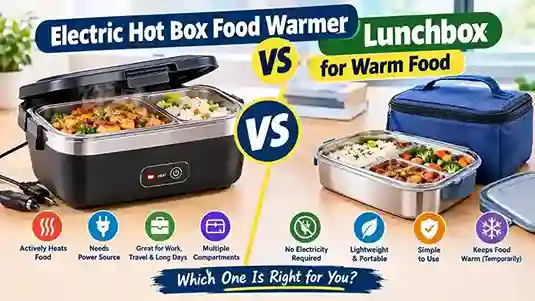
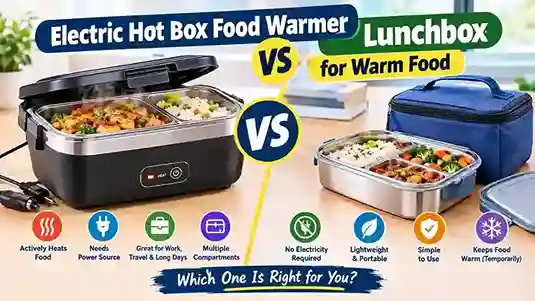
Hot Box Food Warmer vs Lunchbox for Warm Food The main difference when comparing an electric hot box food warmer vs lunchbox is heating ability.
An electric food warmer is designed to passively aid in heating your food when plugged into its proper electrical outlet. A conventional lunchbox just contains the food and keeps its already cooler temperature.
Here are the main differences:
One Super Useful Gift For Your Loved Ones – Top 10 Best Electric Lunch Box Food Warmers
Active heating Yes, depending on model No
Requires power Usually yes No
Keeps food warm Yes Yes, if insulated
Portability Good Excellent
Cleaning Depends on design Usually simple
Best suited to: All-day work and college Half-day trips and daily lunches
Operating cost Uses electricity No electricity required
Heat up time Varies by model and food No
Which One Keeps Food Warmer?
If your primary goal is just to keep the meal warm for as long as possibly, electric food warmer would be the better choice whenever you have compatible power at your disposal.
A more traditional insulated lunchbox can hold heat, but it cannot replace heat lost after food sits for a while. If you made a hot meal and packed it warm in the morning, by the time you open it hours later, it’ll be semi-warm and not steaming.
When plugged in, an electric warmer is capable of supplementing heat, but how well it performs depends on the, as well as your models cooking level and starting temperature, ambient temperature and heating design.
Always follow the manufacturer guidelines instead of presuming that every electric warmer is like heating food.
Portability Comparison
On the other hand, traditional lunch boxes are easier and more portable, as you can pack lunch in a few seconds. And, no need to hunt for an electrical outlet or lug around a power cable.
The one drawback to an electric hot box is that it might not be portable, you will need to carry its power cable/adapter with you. Nonetheless, the vast majority of electric food warmers are portable by default.
If you roam from place to place, the preference depends on whether power is available.
An electric warmer is also very handy when you use to go work in an office with a wall socket regularly. An insulated lunchbox makes more sense if you are out all day or in places without electricity.

Ease of Use
A classic lunch container is very simple to use. All you have to do is pack your meal, close the lid and go.
If you use an electric warmer, you’ll need to include one extra step. You hook it up to the right power source and use it per instructions set forth by the manufacturer.
However, though PS4 controllers can be difficult to connect, once connected, the warmer does make eating a warm meal easier.
This slight extra measure may be worth the trouble for those who frequently dine at a desk or in an office.
Cleaning and Maintenance
Cleaning is another important consideration.
Regular lunch boxes tend to be less complex, hence much easier to wash. Most have removable containers that can be washed separate from the temperature and moisture gauge.
Use: Electric food warmers need a bit more care. The key is to remove the food container, which usually needs no cleaning after each use while protecting electrical elements from water as instructed by the manufacturer.
If warmth is not through plates/surface, check if the container inside for oil is removable and what exactly are the cleaning instructions per the manufacturer.
Having to remove a separate container makes routine maintenance significantly less of a chore.
Better for Office Workers?
Electric hot box food warmer is the best option available for office goers if you have a proper electric outlet to use.
Instead of counting only on the insulation from your lunchbox warmer, you can use the heater function of your warmer as based on its manual. This is useful if the time between leaving home and your lunch break is several hours.
For workers who are sticklers for simplicity, or those without access to an outlet, a classic insulated lunchbox could still be perfect.
If you are going to be working somewhere where the access to electricity is limited, an insulated lunchbox may serve you better.
Which Is Better for Students?
Different school or college settings necessitate varied student demands.
A conventional lunchbox might be more convenient for students because no power is needed. Is also lightweight and easy use.
May work well if students have reasonable access to power and are permitted to use the appliance.
Other factors to consider before going electric include size, weight, sturdiness and cleaning exigencies.
Which Is Better for Travel?
The task of deciding becomes even more difficult with travelling.
An electric warmer is a great option if you are traveling by car with any power source available in your gun safe. Only use the supplied power source and adapter as per the manufacturer.
If you are flying, going to be outside or anywhere that doesn’t have electricity a classic insulated lunchbox might be more suitable.
This means the most suitable option for travelling will completely rely on your destination and how long you need to keep your meal hot.
Energy Use
Since the traditional lunchbox does not consume electrical energy during use, it does not need electricity to be functional.
Electric food warmer works by consuming electricity. The possible amounts vary with its power rating and the time it’s net.
This is not such a big deal if you use it occasionally. But users of an electric warmer every day may want to confirm the device’s power specs before purchase.
Safety Considerations
Safety always comes first when dealing with an electric food warmer.
You must read the manufacturer’s instructions before using it. 5. Only use the power supply, cable and adapter that is recommended. Do not use a damaged cable or electrical component
Do not put water or food directly into areas that do not keep food.
If the device offers a detachable food container, use this as directed. Never take for granted an electric lunchbox is waterproof just because it holds food.
Another essential point is to store your food properly. Store perishable food at safe temperatures and follow proper food- safety practices.
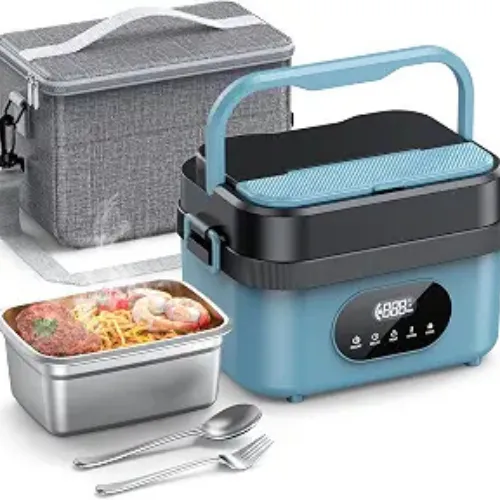
Benefits of an Electric Hot Box Food Warmer
The advantages of electric food warmer include:
While on, it can passively warm food.
Good for long days at work.
This can be useful for those people who prefer warm meals.
Most models are portable.
Many even have food compartments in them.
This will come in handy if no microwave is available.
As far as heat performance goes, keep in mind that it differs depending on the products.
Advantages of a Traditional Lunchbox
The advantages of traditional lunchboxes are also significant:
No electricity is required.
They are often quite pretty simple to work.
They are easy to carry.
From all price ranges, they are available.
They can be easy to clean.
Insulated versions maintain heat in food items.
They come in handy for wandering outside and for traveling.
Part 2 : The solution If you just want something simple, a decent enough insulated lunchbox may be all it takes.
Electric Hot Box or Lunchbox: What To Go For?
It all depends on the lifestyles, which optional you went with.
Opt for an electric hot box food warmer if:Electric Hot Box Food Warmer vs Lunchbox for Warm Food
We need a hot-meal hours later after leaving our home.
You are connected to an appropriate power source.
You operate in an office or any site with electricity.
You have no microwave available.
You are looking for a solution that can heat food live.
So when do you opt for a classic lunchbox?
You can’t rely on electricity.
You want maximum simplicity.
You frequently travel outdoors.
You want a lightweight option.
You will only need to is keep food warm temporarily.
Final Verdict
Comparison on Electric Hot Box Food Warmer Vs Lunchbox for Warm Food boils down to your requirements.
The plain lunchbox is portable, easy to use and does not need electricity. An insulated model can keep freshly packed food on a specific temperature.
Another feature of the electric hot box food warmer is that it’s used to keep food actively warm when connected to a suitable power source. Particularly useful for workers in offices (or anywhere else with power), or travelers who will have access to juice at some point, and anyone that wants a hot meal the later half of the day.
If you value convenience and heating food slowly, the electric food warmer might be for you. If simplicity, portability and no electricity is paramount to you, than an old school insulated lunchbox may be the better way.
Consider the size, material used, insulation, how to clean after usage power requirements, safety measures needed and food you typically carry before making a purchase for any type. Going for something that fits your day to day routine will keep you from making lunchtime a chore.