


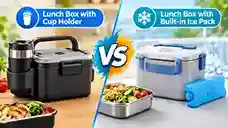
Lunch Box with Cup Holder vs Lunch Box with Built-in Ice Pack Choosing whether to purchase a lunch box with a cup holder or one with an integrated ice pack will depend on your schedule, how much food you plan to store in the lunch box, and what you prefer. Both types of lunch boxes have practical advantages, however they serve different purposes. While one provides additional convenience for carrying your beverage, the other can assist in keeping your food cool and fresh for extended periods.
Whether you’re a student, professional, traveler, or outdoor enthusiast, choosing the proper lunch box will help simplify your mealtime routine. We’ll be comparing the benefits and disadvantages of each option as well as their top features, pros, cons, and recommended applications so that you can choose the one that works best for your needs.
1. Lunch Box with Cup Holder
A lunchbox that includes a built-in or attached cup holder is an excellent option for those who would prefer to take their meal and drink together. The holder itself provides a designated space for a water bottle, travel mug, etc., and therefore, can eliminate the need to carry both a beverage bag and a lunchbox.
Many types of lunch boxes are designed with insulating materials on all sides (including the lid), strong carrying handles, locking mechanisms for security, and large internal storage areas. Although some models have insulated walls, there are differences in the level of insulation used in each model, therefore a cup holder does not necessarily provide food cooling features. If you are regularly traveling to work, attending school/classes, or eating outside, this lunch box may assist you in organizing your items while allowing easy access to them.
Value
The greatest benefit of using a lunch box that has a built-in cup holder is its convenience. It allows you to transport both your meal and your beverage together in one neatly organized manner which makes it ideal for use while traveling to and from school/work, and for other short journeys.
Depending upon the way that the lunch box was built it might also have insulation, individual compartments and an easy to carry handle. These characteristics will make daily use easier with out needing to purchase other items.
Key Features
Built-in cup holder: Provides a designated place for a compatible bottle or cup.
Portable design: Makes transporting meals and drinks easier.
Insulated construction: Some models help maintain food temperature.
Storage areas: Many models include storage for food items, such as snacks and condiments, as well as eating utensils, and other smaller storage containers.
Convenient handle: Helps with carrying during daily travel.
Variety of styles: Available in different colors, sizes, and materials.
Make sure that you measure the holder’s diameter and depth prior to buying it in order to determine whether or not your desired bottle will fit snuggly.
Pros
Keeps your drink and meal together.
Reduces the need for an extra carrying bag.
Makes water bottles easier to access.
Suitable for school, work, commuting, and picnics.
Some models include additional storage compartments.
Available in a range of sizes and designs.
Cons
The cup holder takes up additional space.
Some holders may not fit wide bottles or large tumblers.
It does not necessarily keep food cold.
A bottle may become unstable if the holder is shallow.
Larger models may be less compact than simple lunch bags.
Recommended
A lunch box equipped with a cup holder would be ideal for those that consume a drink such as water, juice, etc., on a daily basis. The use of this type of lunch box may be especially beneficial to students, office workers, commuters, and anyone else who prefers to organize their lunch items when transporting them.
Select a model which has a stable support system for holding the product in place, uses strong materials to last long, and can hold enough food internally so that it will accommodate your typical meal size.
Best For
Students: Carrying lunch and a water bottle to school or college.
Office workers: Keeping meals and drinks together during the workday.
Commuters: Organizing daily food and beverage essentials.
Travelers: Carrying snacks and drinks for short journeys.
Outdoor activities: Taking lunch on suitable day trips and picnics.

2. Lunch Box with Built-in Ice Pack
The design of a lunchbox with an integrated ice pack allows you to store your meal and maintain its temperature when traveling or being out of the house. Depending upon the type of lunchbox, the cooling component can be either located in the lid, inside of a compartment within the lunchbox itself, or included as a separate frozen pack. This style of lunchbox is especially beneficial for storing meals that require refrigeration until consumption.
In addition to the ice pack, the cooling effectiveness of this type of lunch box will also depend upon the insulation, the ambient temperature, and how frequently the lid is opened. If you are packing perishables such as yogurt, fruit, cheese, sandwiches, salads, etc., then this style of lunch box may be an acceptable choice. Follow the manufacturer’s guidelines for safe food storage and use additional cooling methods as needed.
Value
The most significant benefit of an ice-packed lunch box is the way it creates and maintains a cold environment for items you pack. An ice-packed lunch box will help eliminate the need to buy disposable ice packs, and it also provides you with an organized cooling option for each meal you prepare on a daily basis.
The design can help make carrying your lunch from home easier. The ice packs are typically frozen prior to use, and how long they will remain cold depends on which brand you choose.
Key Features
Cooling element: Helps keep the interior cool when properly prepared.
Insulated walls: Slow the transfer of heat from the surrounding environment.
Integrated or removable ice pack: The exact design depends on the product.
Food storage compartments: Some models separate different food items.
Portable construction: Suitable for work, school, and travel.
Reusable cooling system: Many models allow the ice pack to be frozen and reused.
Check if the ice pack is removable, how long it takes to freeze, and if there’s any specification from the manufacturer regarding cooling time.
Pros
Helps keep perishable foods cool.
Suitable for fruit, yogurt, sandwiches, and salads.
Can reduce reliance on disposable cooling packs.
Supports meal preparation and food transportation.
Some models combine cooling with insulated storage.
Useful for warm-weather travel when used correctly.
Cons
The ice pack may need several hours in a freezer before use.
Cooling performance decreases as the pack warms.
Some designs offer limited space for larger meals.
Additional cooling may be needed for extended trips.
The lunch box may be heavier when fully packed.
The cooling element requires proper cleaning and maintenance.
Recommended
A lunch box equipped with an ice pack would be most appropriate for people carrying refrigerated items such as lunches, dairy products, fresh fruits, or any type of food that requires refrigeration. This type of lunch box would also be beneficial to people who are unable to utilize the refrigeration facilities available at their workplace (such as office employees), college students, individuals on day trips, and people preparing meals ahead of time.
Find an insulated style that has a dependable ice pack and is sized to hold the amount of food you typically eat.
Best For
Meal preparation: Keeping packed ingredients cool until mealtime.
Office lunches: Transporting perishable meals when refrigeration is unavailable.
Students: Carrying suitable chilled snacks and lunches.
Picnics: Helping maintain cooler temperatures during short outings.
Summer travel: Providing additional cooling support in warm weather.

3. Lunch Box with Cup Holder vs Lunch Box with Built-in Ice Pack: Main Differences
Although both products help transport meals, their main benefits are different. A cup holder prioritizes beverage convenience, while an ice pack prioritizes cooling.
| Feature | Lunch Box with Cup Holder | Lunch Box with Built-in Ice Pack |
|---|---|---|
| Main purpose | Carrying drinks and meals together | Helping keep food cool |
| Beverage storage | Dedicated holder on many models | Depends on the design |
| Cooling | Not guaranteed | Cooling element included |
| Freezer required | Usually not for the holder | Usually required for reusable ice packs |
| Best food types | General packed meals | Chilled and perishable foods |
| Portability | Convenient for daily commuting | Convenient for chilled meal transport |
| Maintenance | Clean the holder and container | Clean the container and maintain the ice pack |
| Main advantage | Easy access to drinks | Improved cooling support |
The best option depends on what matters most during your day. If you mainly need a practical way to carry a drink, a cup holder is useful. If keeping food chilled is your priority, a lunch box with an ice pack is generally the better choice.
4. Which Lunch Box Offers Better Food Storage?
Food storage depends on capacity, compartment design, insulation, and the type of meals you pack. A lunch box with a cup holder may provide enough room for sandwiches, rice, pasta, or other everyday meals, but the holder itself does not guarantee temperature control.
A lunch box with a built-in ice pack is more suitable for meals that require cooling. It can help maintain a lower temperature, especially when combined with insulated walls and a properly frozen pack.
Remember that an ice pack does not automatically guarantee safe temperatures throughout the day. Perishable foods should generally be kept at or below 40°F (4°C). For extended storage, use an appropriate insulated cooler and sufficient frozen cold sources, and follow food-safety guidance.
5. Which Lunch Box Is Better for Work and School?
For work and school, the better choice depends on your schedule and lunch habits.
A lunch box with a cup holder is useful if you carry a reusable water bottle every day. It makes daily transportation simpler and keeps your drink close to your meal. This design is especially practical for people who walk, commute, or move between classes and work areas.
A lunch box with a built-in ice pack is a better option if your lunch includes yogurt, cheese, fresh salads, or other perishable ingredients. It can help maintain cool conditions until lunchtime, provided the pack is properly frozen and the container is used according to its instructions.
If you need both features, look for a lunch box that includes a bottle holder and an effective cooling system. Just make sure the added features do not reduce the usable space you need.
6. Which Lunch Box Is Better for Travel and Outdoor Activities?
Travel introduces different challenges, including changing temperatures, limited refrigeration, and the need to carry food comfortably.
A cup-holder lunch box works well for short journeys when carrying a drink is important. A secure holder can reduce the chance of your bottle moving around inside the bag. However, it is worth checking how the lunch box closes and whether the holder can accommodate your bottle.
For outdoor activities, a lunch box with an ice pack can provide better cooling support for chilled foods. This can be useful during picnics, day trips, and outdoor work. For longer journeys or particularly warm conditions, a larger insulated cooler with sufficient ice packs may be more appropriate.
Choose a container that is easy to carry, simple to clean, and suitable for the length of your trip.
7. Buying Guide: What Should You Check Before Purchasing?
Before buying either option, consider the following factors.
Size and Capacity
Check the internal dimensions and capacity. A large exterior does not always mean the container has more usable storage space. Make sure it fits your normal lunch, snacks, and any additional containers.
Insulation Quality
If temperature control matters, review the insulation materials and manufacturer specifications. A cup holder alone does not provide cooling, while an ice pack’s effectiveness depends on the entire container design.
Material and Durability
Look for sturdy construction, reliable closures, and materials that are easy to maintain. If food comes into direct contact with the container, follow the manufacturer’s cleaning and food-contact instructions.
Ease of Cleaning
Removable parts can make cleaning easier. For an ice-pack model, check whether the cooling element can be removed and how it should be cleaned. For a cup-holder model, make sure the holder does not trap spills or debris.
Price and Value
Compare the overall value rather than choosing solely by price. Consider durability, usable capacity, included accessories, cooling performance, and warranty coverage.
Portability
Check the handle, weight, dimensions, and carrying comfort. A compact container may be better for a backpack, while a larger model may work well for car travel.
8. Common Mistakes to Avoid Lunch Box with Cup Holder vs Lunch Box with Built-in Ice Pack
When comparing a lunch box with a cup holder vs a lunch box with a built-in ice pack, avoid assuming that all insulated containers perform the same way.
- Ignoring cooling needs: A cup holder does not keep perishable foods cold.
- Forgetting to freeze the ice pack: An unfrozen pack cannot provide the same cooling performance.
- Choosing the wrong size: A container that is too small may not fit your meal or bottle.
- Overlooking cleaning requirements: Hard-to-clean areas can make daily maintenance inconvenient.
- Ignoring product instructions: Follow the manufacturer’s guidance for freezing, washing, and food storage.
- Expecting unlimited cooling: Ice packs gradually warm, especially in hot conditions.
Considering these details before buying can help you select a lunch box that suits your routine.
Conclusion
The choice between a lunch box with a cup holder and a lunch box with a built-in ice pack comes down to your priorities.
Choose a lunch box with a cup holder if you want to carry your meal and drink together, prefer easy access to a water bottle, and mainly pack foods that do not require additional cooling.
Choose a lunch box with a built-in ice pack if you regularly carry chilled or perishable foods and want extra cooling support during transportation. For the best results, combine the ice pack with suitable insulation and proper food-handling practices.
Overall, the lunch box with a cup holder is best for beverage convenience, while the lunch box with a built-in ice pack is best for keeping food cool. Neither is universally better; the right product is the one that matches your meals, schedule, and storage needs.
Frequently Asked Questions (FAQ)
1. What is the difference between a lunch box with a cup holder and one with a built-in ice pack?
A lunch box with a cup holder provides a dedicated place for carrying a drink. A lunch box with a built-in ice pack includes a cooling element designed to help keep food cool. Your choice depends on whether beverage convenience or food cooling is more important.
2. Does a lunch box with a cup holder keep food cold?
Not necessarily. A cup holder is intended to carry a beverage. The lunch box may have insulation, but you should check the product specifications to determine whether it provides temperature control.
3. How long does a lunch box with a built-in ice pack keep food cold?
Cooling time varies according to the ice pack, insulation, surrounding temperature, and how frequently the container is opened. Check the manufacturer’s stated performance and use a food thermometer when necessary to verify safe storage temperatures.
4. Can I put an ice pack inside a lunch box with a cup holder?
Yes, if there is enough room and the manufacturer permits it. A separate reusable ice pack may provide additional cooling, but make sure it fits properly and does not damage the container or interfere with its closure.
5. Which lunch box is better for school?
A cup-holder lunch box is convenient for students who carry water bottles. A lunch box with a built-in ice pack is more suitable for students who need to keep perishable foods cool. The best choice depends on the meal and the availability of refrigeration.
6. Is a lunch box with a built-in ice pack reusable?
Most reusable ice packs can be frozen and used repeatedly according to the manufacturer’s instructions. Inspect the pack regularly and stop using it if it leaks, cracks, or becomes damaged.
7. What should I look for when buying a lunch box with a built-in ice pack?
Look for effective insulation, a suitable capacity, a reliable ice pack, easy cleaning, durable construction, and clear cooling instructions. Consider whether the ice pack is removable and how long it needs to freeze.
8. Can I use both a cup holder and an ice pack in the same lunch box?
Yes. Some lunch boxes combine beverage storage with insulated compartments or cooling accessories. If you want both benefits, check the product’s design, capacity, and cooling specifications before purchasing.


1 Comment
Good